


HOMER (800 BC)
Homer was a Greek poet who is credited as the author of the Iliad and the Odyssey, two epic poems that are foundational works of ancient Greek literature. Homer is considered one of the most revered and influential authors in history.
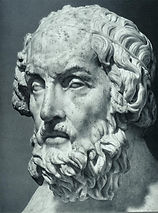
AESCHYLUS (524-455 BC)
Aeschylus was an ancient Greek tragedian, and is often described as the father of tragedy. Academic knowledge of the genre begins with his work, and understanding of earlier Greek tragedy is largely based on inferences made from reading his surviving plays.

SOPHOCLES (497-406 BC)
Sophocles was an ancient Greek tragedian, known as one of three from whom at least one play has survived in full. His first plays were written later than, or contemporary with, those of Aeschylus; also contemporary with those of Euripides. Sophocles wrote over 120 plays, but only seven have survived in a complete form.
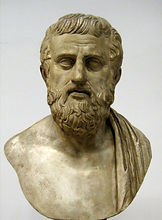

THUCYDIDES (460-400 BC)
Thucydides was an Athenian historian and general. His History of the Peloponnesian War recounts the fifth-century BC war between Sparta and Athens until the year 411 BC. Thucydides has been dubbed the father of "scientific history" by those who accept his claims to have applied strict standards of impartiality and evidence-gathering.

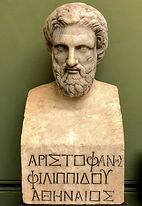
ARISTOPHANES (446-386 BC)
Aristophanes was a comic playwright or comedy-writer of ancient Athens and a poet of Old Attic Comedy. Eleven of his forty plays survive virtually complete. These provide the most valuable examples of a genre of comic drama known as Old Comedy.
PLATO (423-347 BC)
Plato was an ancient Greek philosopher born in Athens during the Classical period in Ancient Greece. In Athens, Plato founded the Academy, a philosophical school where he taught the philosophical doctrines that would later become known as Platonism.
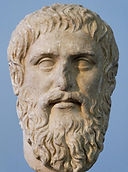
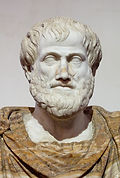
EUCLID (300 BC)
Euclid was an ancient Greek mathematician active as a geometer and logician. Considered the "father of geometry", he is chiefly known for the Elements treatise, which established the foundations of geometry that largely dominated the field until the early 19th century.

APOLLONIUS (240-190 BC)
Apollonius was an Ancient Greek geometer and astronomer known for his work on conic sections. Beginning from the contributions of Euclid and Archimedes on the topic, he brought them to the state prior to the invention of analytic geometry.

VIRGIL (70-21 BC)
Publius Vergilius Maro, usually called Virgil or Vergil, in English, was an ancient Roman poet of the Augustan period. He composed three of the most famous poems in Latin literature: the Eclogues (or Bucolics), the Georgics, and the epic Aeneid.
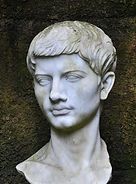
MARCUS AURELIUS (161–180 AD)
Marcus Aurelius Antoninus (26 April 121 – 17 March 180) was Roman emperor from 161 to 180 AD and a Stoic philosopher. He was the last of the rulers known, non-contemporaneously, as the 'Five Good Emperors' and the last emperor of the Pax Romana... an age of relative peace, calmness, and stability for the Roman Empire lasting from 27 BC to 180 AD.
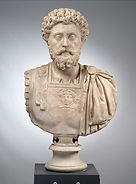
PTOLEMY (100–170 AD)
Claudius Ptolemy, was an Alexandrian mathematician, astronomer, astrologer, geographer, and music theorist, who wrote about a dozen scientific treatises, three of which were of importance to later Byzantine, Islamic, and Western European science:
the Almagest, the Geography, and the Tetrábiblos.
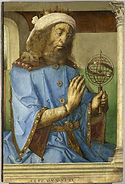
NICOMACHUS (60-120 AD)
Nicomachus was an Ancient Greek Neopythagorean philosopher from Gerasa; Nicomachus' work on arithmetic became a standard text for Neoplatonic education in Late antiquity.
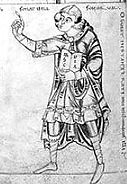
ST. AUGUSTINE (354–430 AD)
Augustine of Hippo, also known as Saint Augustine, was a theologian and philosopher of Berber origin a bishop from Roman North Africa. His writings influenced the development of Western philosophy and Western Christianity, and he is viewed as one of the most important Church Fathers in the Patristic Period. His important works include The City of God, On Christian Doctrine, and Confessions.
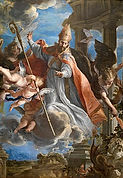
PLOTINUS (205-270 AD)
Plotinus was a Hellenistic Platonist philosopher, born and raised in Roman Egypt. Plotinus is regarded by modern scholarship as the founder of Neoplatonism.
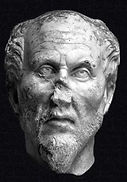
DANTE ALIGHEIRI (1265–1321)
Often referred to as Dante, he was an Italian poet, writer and philosopher. His Divine Comedy, is widely considered one of the most important poems of the Middle Ages and the greatest literary work in the Italian language.

GEOFFREY CHAUCER (1340-1400)
Chaucer was an English poet, author, and civil servant best known for The Canterbury Tales. He has been called the "father of English literature", or, alternatively, the "father of English poetry".
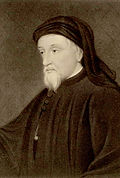
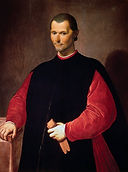
NICCOLò MACHIAVELLI (1469-1527)
Machiavelli was an Italian diplomat, author, philosopher and historian who lived during the Renaissance. He is best known for his political treatise The Prince (Il Principe), written around 1513 but not published until 1532. He has often been called the father of modern political philosophy and political science.
NICOLAUS COPERNICUS (1473-1543)
Copernicus was a Renaissance polymath, active as a mathematician, astronomer, and Catholic canon, who formulated a model of the universe that placed the Sun rather than Earth at its center.


